
What is Math & Movement™?

Download a Flyer about Math & Movement™

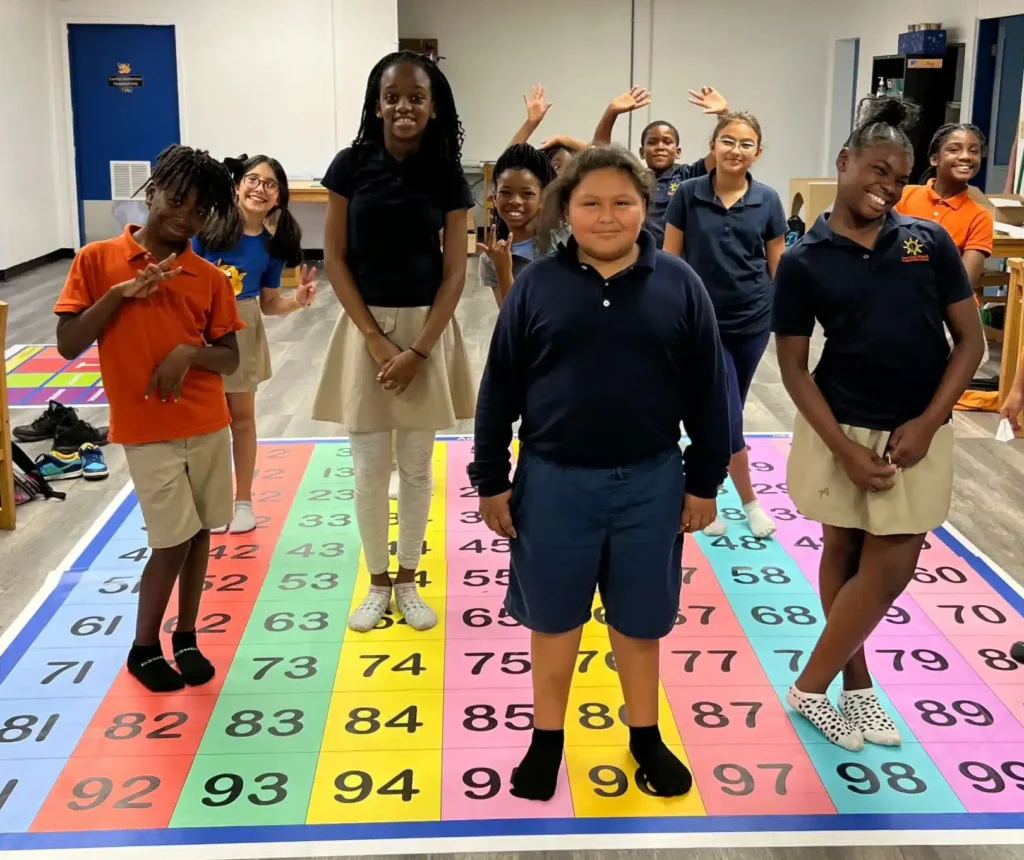
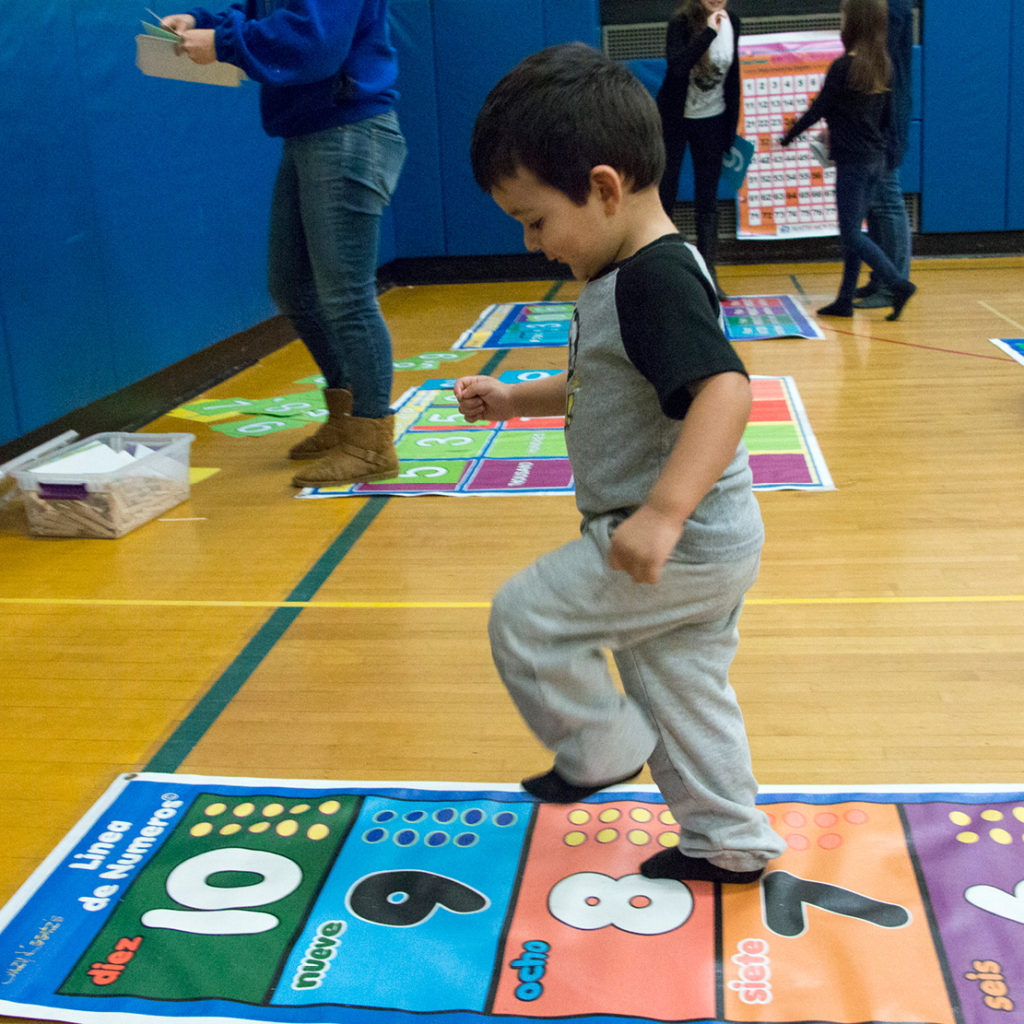
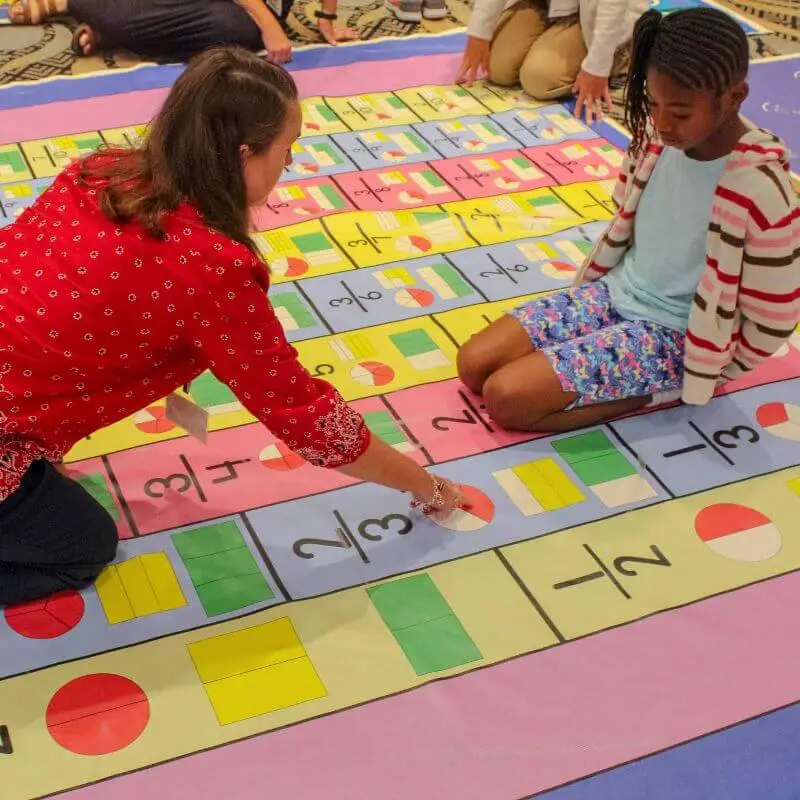
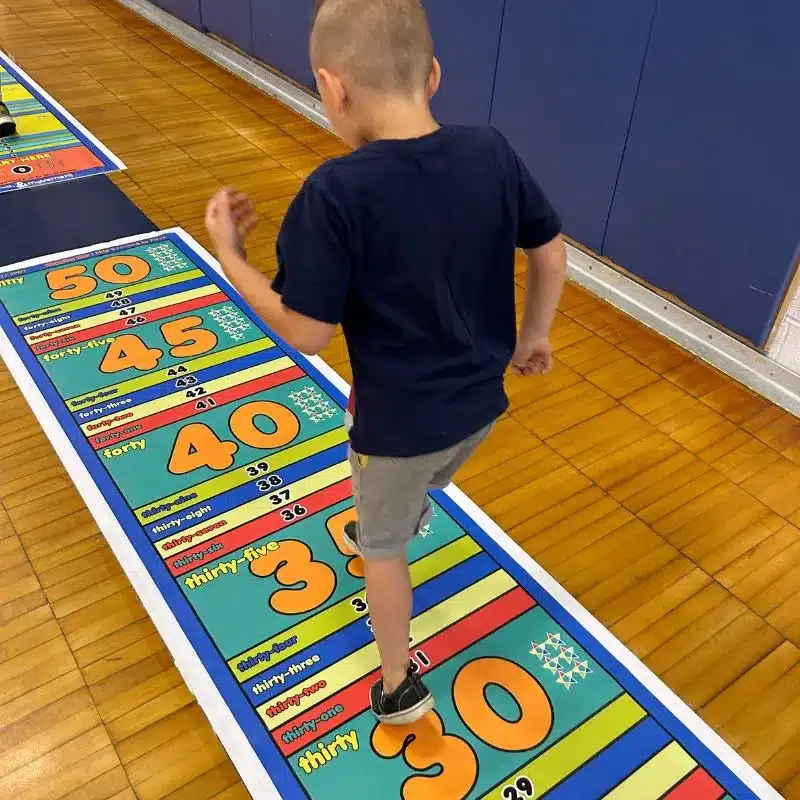
Math & Movement™ is a kinesthetic, multi-sensory approach to teaching math that incorporates physical exercise, stretching, cross-body movements, yoga, and visually-pleasing floor mats designed to encourage students to practice math concepts. The Math & Movement™ program allows students to physically hop, walk, crawl, dance or touch the mats and banners as they learn thus using more learning modalities (visual, auditory, motor and kinesthetic) when practicing.

Math & Movement™ begins at pre-K and harnesses children's natural love of movement and creative imagination to master basic math concepts. The floor mats and banners cover the concepts of addition, subtraction, telling time, skip-counting, multiplication, division, fractions, factoring, positive/negative numbers, Cartesian coordinates, money, unit circle, place value, decimals, percents, rounding and probability.

The movements in the Math & Movement™ program help the student master math while simultaneously offering teachers and students an overall sense of well-being. Incorporating these exercises during the day, before testing or during transitions, allows teachers and students to feel energized, focused, calm, and prepared to learn.

Some examples of the Math & Movement™ movements are the Nine's Twist, Criss Cross for 7's, Sailboat Sway, Jaguar Tummy Rub, Gorilla Leg Lifts, Bunny Hop, The Letter "L" Laughs and Skyscraper.

Download a sample movement

Order a Math & Movement™ Program

The movements are divided into six categories:

  • Active Math:Whisper/Loud Movements - Designed to give your students physical exercise while simultaneously enhancing math and reading ability.
  • Active Math:Skip Counting Movements - Designed to provide additional physical exercise while learning the multiples.
  • Sit-Down Math Activities - Designed for quiet time and involve stretching.
  • Tapping at the Table Activities - Designed to be used in between other activities, while students sit at their desks.
  • Hallway Math Activities - Designed to be used walking in the hallway to and from lunch, PE, art, music, computer or library.
  • Math 'n Yoga Activities - Incorporate math practice into popular yoga moves.

What Math & Movement™ Does

  • Strengthens numeracy and literacy
  • Supplements existing curriculums
  • Allows children to exceed state standards
  • Integrates core subjects
  • Engages all learners
  • Is researched-based
  • Supports equity
  • Adds additional PE minutes while reinforcing learning
  • Is developmentally appropriate for pre-school children whose abstract thinking skills are not fully developed

In addition, Math & Movement™:

  • Makes learning a pleasurable experience for children thus motivating children to increase their practice time.
  • Makes math and reading concepts accessible to children beginning in pre-K, and earlier than possible with traditional approaches.
  • Makes math and reading concepts more understandable to students.
  • Allows students to practice at a level of comfortable success.
  • Allows students to practice and learn more thoroughly.
  • Engages the interest of students and appeals to their natural inclination for movement.
  • Helps schools to reach their equity goals as it allows more students to gain understanding of the concepts.
  • Facilitates the process of teaching. It makes it possible for older students to teach younger students while simultaneously gaining understanding of previously misunderstood concepts.
  • Offers efficiency in that it allows students to be physically active while learning and practicing math and reading concepts.

In conjunction with math educators, Math & Movement™ has developed a set of activities that are designed to help teachers and parents create a love of math and an interest in continuing math education in children. Our activities include many cross-body movements that build the connections between the two halves of the brain, making skills acquisition easier for all types of learners. Our program is designed to be used in the classroom and at home, by math teachers, classroom teachers and parents. When implemented as described, the program will encourage math learners to feel confident in acquiring and retaining math fundamentals.

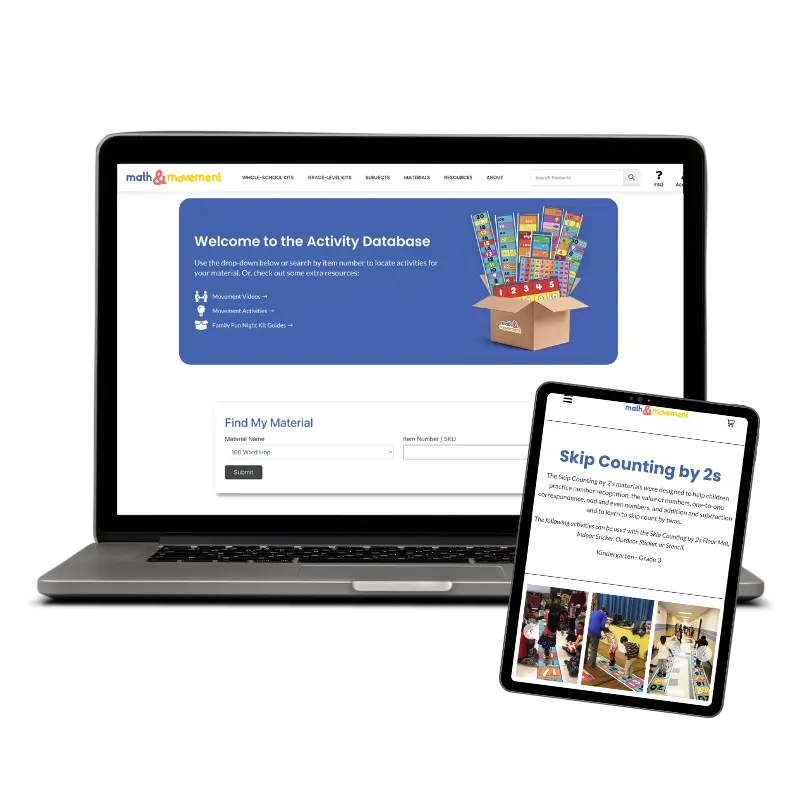
We provide free activity guides here on our website for our classroom mats and banners. The mats and banners materials and other math items such as games, books and manipulatives, can be purchased through our Math Made Fun shop. We also conduct Math & Movement™ workshops nationwide for school and parent groups, including several online offerings.

Does Math & Movement really work?

A recent National Math Panel report encourages more practice of basic math skills. "Few curricula in the United States provide sufficient practice to ensure fast and efficient solving of basic fact combinations and execution of the standard algorithms." (National Mathematics Advisory Panel-Final Report, page 26). Practice is necessary for competence, but many children resist and/or resent doing math drills. Math & Movement™ allows children to enjoy practicing math basics while engaging in fun activities that keep them interested.

Many research studies have shown that movement enhances learning. Too much sitting results in decreased circulation and a subsequent decrease in concentration, while certain kinds of movement stimulate the release of dopamine and noradrenalin in the brain, which are important in learning. According to Dr. John Ratey, author of Spark: The Revolutionary New Science of Exercise and the Brain states "I cannot underestimate how important regular exercise is in improving the function and performance of the brain. Exercise stimulates our gray matter to produce 'Miracle-Gro' for the brain." This refers to the brain chemical BDNF (brain-derived-neurotropic factor). Exercise stimulates the brain to produce extra BDNF. The extra BDNF helps new neurons (and their connections) to grow.

According to Carla Hannaford, PhD, author of Smart Moves: Why Learning Is Not All in Your Head (Great River Books, 2005), "The more closely we consider the elaborate interplay of brain and body, the more clearly one compelling theme emerges: movement is essential to learning. ... Movement awakens and activates our mental capacities. Movement integrates and anchors new information and experience into our neural networks. Moving while learning increases learning."

Eric Jensen writes "Research suggests that physical activity benefits learning. Movement increases heart rate and circulation, enhances spatial learning, provides a break from learning, allows cognitive maturation, stimulates the release of beneficial chemicals, counteracts excessive sitting, and affirms the value of implicit learning." Moving With the Brain in Mind, Educational Leadership, v58 n3 p34-37 Nov 2000.

The Math & Movement™ program is based on research that suggests that moving during learning facilitates muscle memory, an important factor with younger children whose abstract thinking skills are not fully developed.

The Math & Movement™ program is also based on research suggesting that cross-body movements integrate the left and right hemisphere of the brain. Cross-body movements are when the left arms or legs cross over to the right side of the body or right arms or legs cross over to the left side of the body. These movements wake up a "sleepy" brain and help to cement newly learned material in the memory.

Math & Movement™ Research

Pre-school

A seven week study with UPK students found Math & Movement™ to be effective in increasing counting ability, number, letter and word recognition and the children's happiness with school and self! The program showed increases in understanding across a broad range of skills:

Download the Teachers' Observation Report

Pre-School A Pre-School B Pre-School C Pre-School D Pre-School E Pre-School F Pre-School G

First Grade

In a classroom of first graders, after 18 hours, Math & Movement™ improved skip counting and multiplication skill, and increased math confidence! In a classroom of first graders, after 18 hours, Math & Movement™ improved skip counting and multiplication skill, and increased math confidence! First graders improved their skip counting ability by more than 550%.

Download Full First Grade Report

First Grade A First Grade B

Second Grade

A four week study found a 50% increase in skip-counting knowledge, the students were engaged and had fun, every student showed an increase in knowledge when tested!

Email for Full Second Grade Report

Second Grade A

We Have a Math Crisis

Americans are lagging behind other countries in math. The PISA (Programme for International Student Assessment) evaluation of 15-year-old students' math scores found that Americans rank 24 out of 29 industrialized nations. America sadly ranks behind 23 countries including Canada, Australia, New Zealand and Spain. In addition, the level of obesity in children is at an all time high. The Math & Movement™ program contributes to the solution of these problems by combating obesity while simultaneously improving math skills and retention.

What are the ramifications of math illiteracy? Recently I visited the space center at Cape Canaveral. I had the pleasure of listening to the story of an astronaut's journey into space. At the conclusion of his talk he shared exciting plans for the future of space travel, colonies on the moon and Mars and future exploration of the universe. However, he said, "This may not be possible because we do not have enough American students who are competent in math." In the US, there are at most 5,000 students studying aerospace engineering contrasted with one Chinese university (out of many) that has over 20,000 students eager to be hired into the space industry. Other professions need math-competent individuals as well. The following fields all depend on math:

  • Medical schools need students competent in math
  • Dentistry, veterinary medicine and other medical fields-all depend on math
  • Engineers build our world and need math
  • The financial industry needs math!
  • There are many fields open to our graduates who are competent in math and many foreign graduates ready to fill the vacancies.

Math is Possible for Everyone!

Many students are giving up on math at a relatively young age; it doesn't have to be this way. Math & Movement™ gives students a successful experience with math before they develop the "I can't do math attitude." It gives them the confidence to take mathematical risks.

Math phobia is rampant among adults with over 60% of Americans affected. Sheila Tobias, author of Overcoming Math Anxiety and Succeed with Math believes that math anxiety begins by feeling uncomfortable with math in elementary school. Math & Movement™ short-circuits math phobia by increasing students' math ability and math confidence.

Commencing Math & Movement™ activities at a young age jumpstarts a child's positive attitude toward math. Math & Movement™ is a movement-based program. The activities catch children when they are still willing to give math a try.

Math is another language. Children are receptive to languages. We believe that unless we include more math for children in pre-school through grade four, we are missing a crucial window of opportunity in the lives of our young children. Because Math & Movement™ allows children to learn through movement and visually pleasing floor mats, math concepts become accessible to young children. The depth of understanding acquired in play-like activities will serve as a base for later construction of more advanced concepts.

The intent of Math & Movement™ is not to create a push-down curriculum but rather to allow children to experience math success before they have developed any "math phobias," or any hint that math is hard!